Paper summary · Journal of Chemical Theory and Computation · 2026
Faster predictions for excited states
Using a learned correction to improve fast estimates of how organic molecules respond to light.
The question
Detailed calculations of excited-state energies are costly when you want to compare thousands of molecules. Could we start with a much faster method and learn where it tends to get things wrong?
The approach
The model combines a graph representation of the molecule with descriptors from an inexpensive ZINDO calculation. It learns the difference between ZINDO and the TDDFT reference, then adds that correction to the fast prediction.
What we found
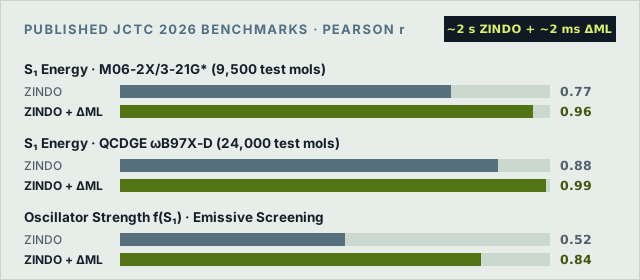
On a test set of 9,500 molecules, the best model raised the correlation for first excited-state energies from 0.77 to 0.96. The reference values were calculated with TDDFT for this benchmark. The paper also tested the approach for oscillator strengths, which describe how strongly a transition can absorb or emit light.
Paper
Predicting S1 TDDFT Energies from ZINDO Calculations Using Message-Passing ΔML with Electronically Informed Descriptors
Adam Coxson, Ömer H. Omar, Marcos del Cueto, and Alessandro Troisi
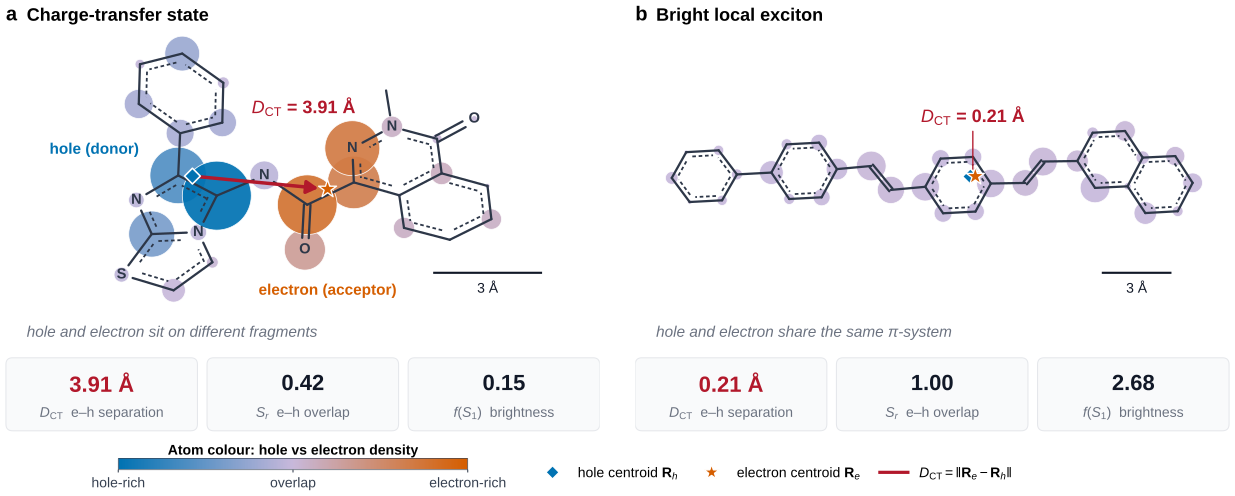
Explore hole–electron charge separation in 3D
Rotate real unseen test molecules spanning Charge-Transfer (CT), Local Exciton (LE), and hybrid states, inspect atomic ZINDO/Multiwfn hole and electron weights, and see why electronic descriptors drive Δ-ML accuracy.
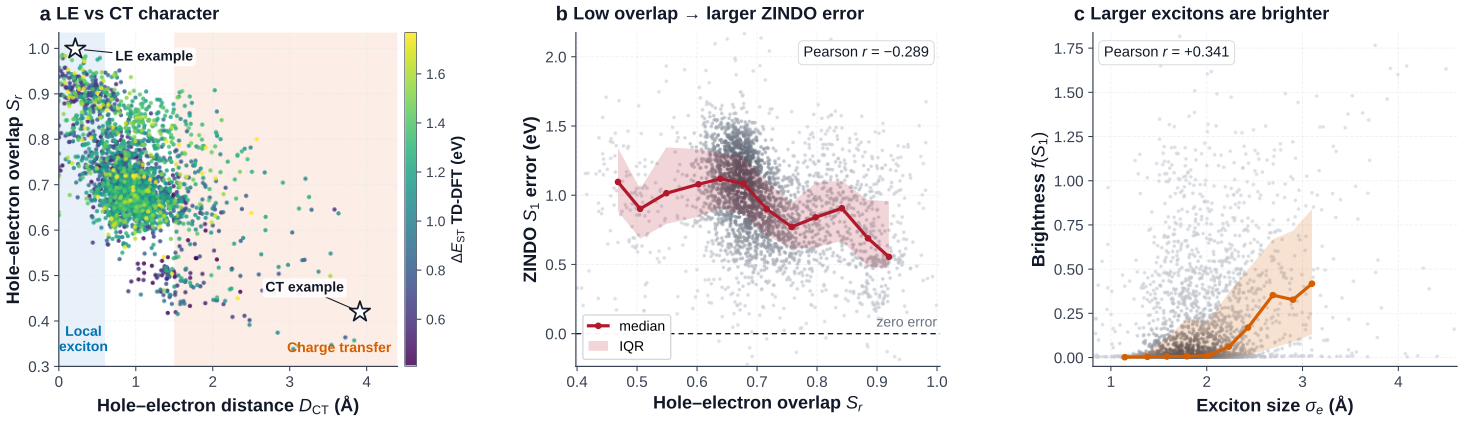
Sneak peek: ongoing Δ-ML development
Papers inbound over this year—new descriptors, new architectures, and lower errors across singlets, triplets, and singlet–triplet gaps (0.00% state-ordering violations across 2,744 unseen test molecules).