PhD Thesis · University of Liverpool · 2026
Electronic structure of conjugated molecules
From density-dependent machine-learned Fock matrices inside the self-consistent field cycle to ΔML-accelerated excited-state predictions.
The question
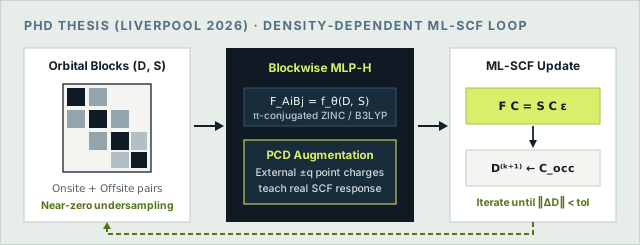
Most machine-learned Hamiltonian models predict a single static ground state from geometry alone. Can we instead learn a density-dependent Fock matrix F(D, S) that sits inside an iterative self-consistent field (SCF) cycle and responds physically to electrostatic perturbations?
The approach
Using extended π-conjugated molecules from ZINC calculated at the B3LYP level, I built blockwise neural models (MLP-H) mapping atomic-orbital density and overlap blocks to Fock blocks, using near-zero undersampling and training on densities distorted by external point charges to improve convergence.
Connection to published work
The second half of the thesis (Chapter 5) developed Message-Passing ΔML-ZINDO for fast excited-state screening, now published in the Journal of Chemical Theory and Computation (2026).
Thesis
Machine learning π-conjugated electronic structure: from density-dependent ML-Hamiltonians to ΔML-accelerated excited states
Adam Coxson · Department of Chemistry, University of Liverpool (2026)
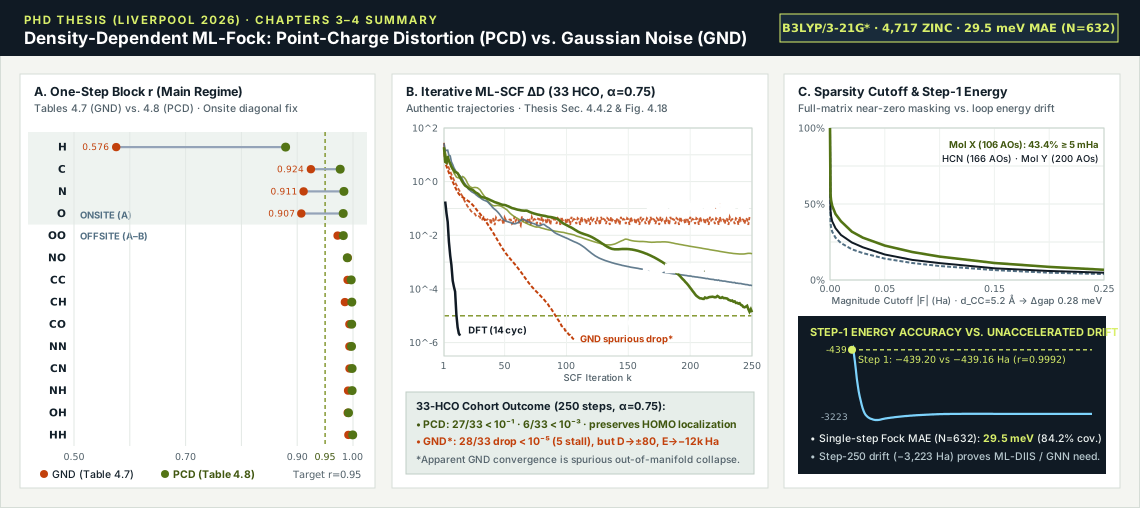
Point-Charge Distortion (PCD) vs. Gaussian Noise (GND)
Summary of verified thesis benchmarks across one-step block correlations (Tables 4.7 vs. 4.8), 33-molecule HCO ML-SCF trajectories, and near-zero matrix sparsity.
Interactive ML-SCF & Fock-block explorer
Inspect real thesis test molecules (including ZINC000033835654 and ZINC000068719623), vary the near-zero magnitude cutoff on authentic Fock blocks, and compare DFT, PCD-trained, and GND-trained SCF trajectories step by step.