Inverse Problems · 2022
Conductivity maps for graphene
Quick preview
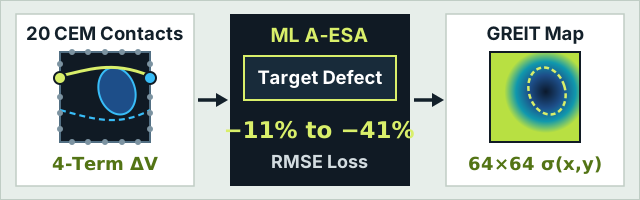
We used machine learning to choose which electrodes to measure with, then tested conductivity reconstruction on a graphene laminate film.
I use physics-informed machine learning to make calculations for molecules and materials more practical at scale.
Inverse Problems · 2022
We used machine learning to choose which electrodes to measure with, then tested conductivity reconstruction on a graphene laminate film.
J. Chem. Theory Comput. · 2026
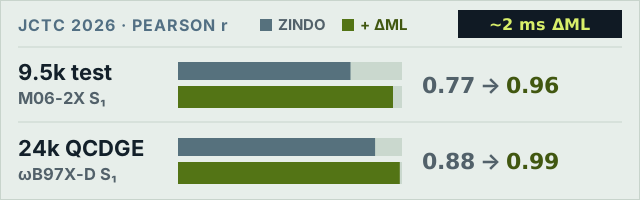
A graph model learns a correction to fast ZINDO calculations. On 9,500 test molecules, the correction increased correlation with TDDFT from 0.77 to 0.96.
PhD thesis · Liverpool · 2026
My thesis looks at two ways machine learning can speed up electronic-structure calculations for conjugated molecules.
The thesis explores how using electron densities distorted by external point charges helps the ground-state model respond to electrostatic changes.
I’m exploring how to use learned corrections to predict more excited-state properties in a single model, including singlet and triplet energies.
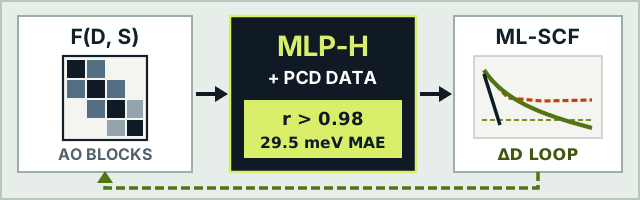
I’m exploring how learned Hamiltonians can describe electronic structure in materials where strain, defects, and spin–orbit effects matter.
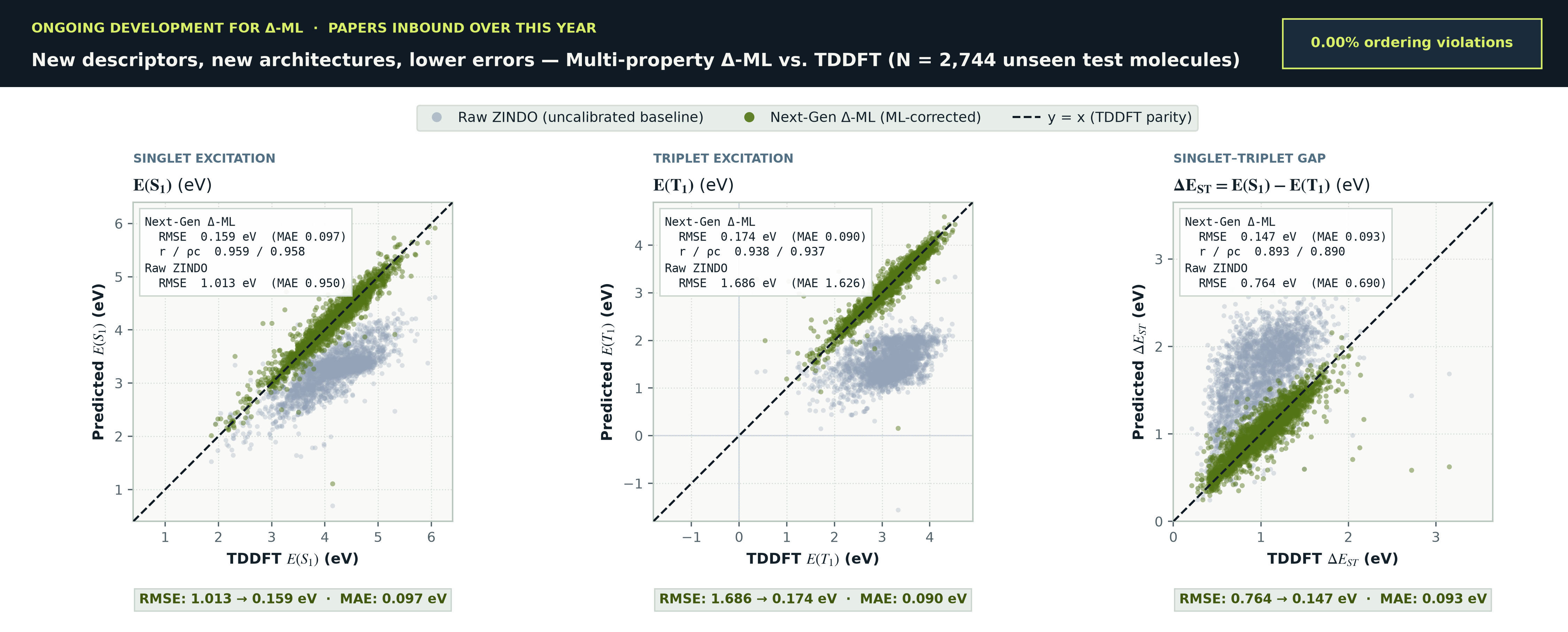
Sneak peek · Ongoing development for Δ-ML · Papers inbound over this year
Extending our 2026 JCTC ΔML-ZINDO framework to joint multi-property excited-state prediction (singlet S₁–S₃, triplet T₁–T₂, frontier orbitals, and ΔEST) with guaranteed physical state ordering.